

Artificial intelligence has become one of the most powerful catalysts in my UX practice — not as a replacement for human creativity, but as an amplifier of it. Over the past year at WebPros, I’ve built an unofficial workflow where AI collaborates with me on everything from early‑stage thinking to system‑level architecture. What began as simple efficiency has grown into a design philosophy rooted in clarity, partnership, and intentionality.
I don’t use AI to replace my expertise; I use it to strengthen it.
This article explores how I use AI inside a multi‑product, legacy‑heavy environment — and how it has elevated my work by giving me the language, clarity, and structure to finally prove the things I’ve been seeing all along. AI didn’t give me new instincts; it gave me a way to articulate them with confidence and evidence!
And before diving in, here’s the truth many designers aren’t noticing yet: the more thoughtfully you use AI, the more indispensable your human thinking becomes. AI didn’t make me replaceable — it helped make my abilities unmistakable. That thread runs through everything that follows.
AI as a Thinking Partner
I use AI the way many designers use a whiteboard: as a place to work through ambiguity, test ideas, and refine thoughts. It’s not that I don’t know what I’m doing — it’s that AI gives me a clearer mirror. It helps me articulate what I already understand instinctively, and it gives me structured backing when I need to explain that thinking to others.
When stakeholders present unclear requirements or messy asks, I already have a strong sense of what they mean and what the real problem is. AI helps me:
- Show the underlying objectives
- Reveal risks and missing logic
- Map dependencies across teams or platforms
- Turn scattered notes into coherent frameworks
It strengthens my original clarity rather than replacing it. In many ways, AI has finally given me the language to prove what I was already seeing — the ability to back my intuition with structure, evidence, and articulation. It hasn’t changed the way I think so much as it has amplified my ability to show how I think. I move from confidently understanding the ask to having the literal, structured backing that helps everyone else see the same thing.
Surfacing hidden patterns
In complex ecosystems — like licensing at WebPros — patterns reveal themselves if you know where to look. I use AI not to find those patterns for me, but to validate, stress‑test, and expand the ones I’m already sensing.
In practice, AI helps me:
- Compare perspectives across Sales, Customer Service, Billing, Licensing, and Engineering
- Highlight places where language or logic diverges
- Surface contradictions I had sensed but hadn’t been able to fully articulate
This support enables me to confidently create:
- Clear, durable mental models
- Cross‑product journeys grounded in real behavior
- Persona‑specific flows that reflect how roles truly interact with the system
- Harmonized UI foundations across multiple products
AI in Research and Synthesis
Research is one of the areas where AI has shifted my workflow the most — not by replacing the thinking, but by letting me stay in the thinking longer. Instead of getting buried under hours of transcripts, I can spend my energy on interpretation, strategy, and meaning‑making.
AI digests hours of conversations from each department, helping me quickly surface the signals within the noise. But I’m the one deciding which patterns matter, what they imply, and how they shape the product.
AI helps me turn raw transcripts into:
- Insights
- Jobs‑to‑Be‑Done
- Contradictions or gaps in understanding
- Product implications
- Functional requirements
This accelerates synthesis while keeping nuance intact — because the nuance comes from me.
AI in UX Architecture & System Design
As my role has evolved toward systems‑level UX, AI has become a partner in architectural thinking. It helps me stretch my ideas, examine assumptions, and articulate complex structures with more clarity and confidence.
AI supports my systems thinking by helping me:
- Outline consistent flow logic
- Transform unique flows into reusable “flow patterns”
- Document why a flow behaves the way it does, so the reasoning doesn’t get lost
This makes the work more scalable. It gives developers, PMs, and other designers a shared map — and gives me space to focus on the higher‑order systems.
AI in Prototyping and Figma Workflows
On the craft side, AI helps me move faster while staying intentional. It doesn’t design for me — it removes the friction so I can spend more of my time on decision‑making, not setup.
Using Figma Make and creating natural‑language prompts with Chet, I can:
- Create UI scaffolding in seconds
- Rapidly explore alternative patterns
- Test variations early without heavy commitment
AI accelerates the mechanical work so I can stay rooted in the conceptual work.
AI for Communication and Alignment
Clear communication is one of the most underrated UX skills, and AI has strengthened mine in ways that feel almost unfair — in the best way. I use AI to collapse hours of meetings, Slack threads, interviews, and product audits into clear, digestible summaries that leaders can act on. AI helps me express information cleanly and strategically, but I decide what matters.
AI helps me craft:
- Confluence documentation
- Product briefs
- Executive summaries
- Rationale decks
It gives me the scaffolding — but the message, the intention, and the direction come from me.
The Philosophy Behind My AI Use
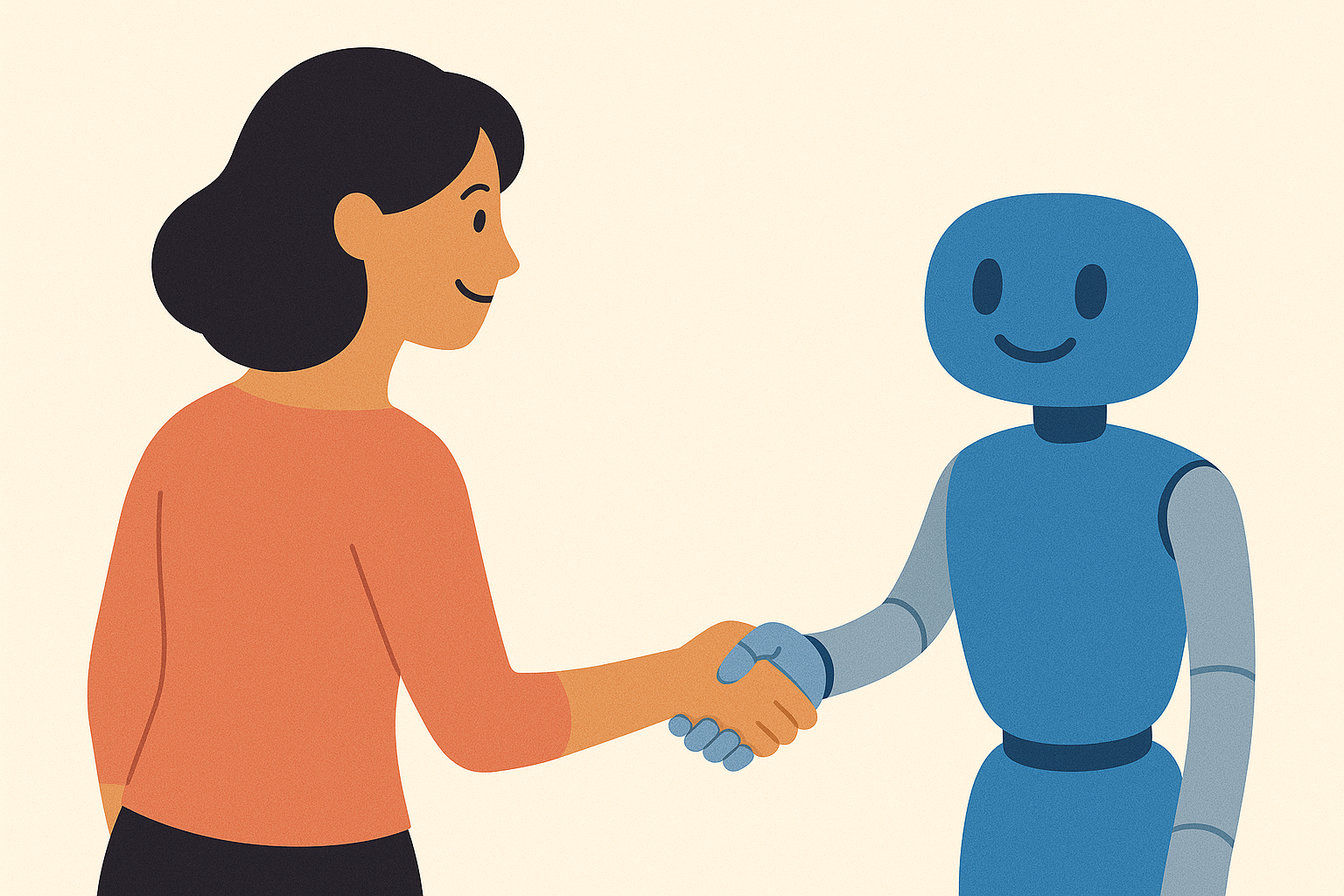
My online book Humannoyed centers on the relationship between humans and technology. A core idea is that tech is a tool, not the point. AI fits perfectly into that philosophy. AI hasn’t replaced my creativity or strategy. It has expanded them.
I still make the decisions.
I still design the systems.
I still define the north star.
AI simply helps me think more clearly, move faster, and design with a wider field of vision. AI has become the most powerful creative augmentation of my career. Not because it automates tasks, but because it illuminates the work — giving voice to intuition, turning patterns into proof, and allowing me to practice UX at a strategic and systemic level with the clarity I always knew I had.
This is the story I want to share — not just about technology, but about how thinking itself changes when you design with AI at your side. And when you use AI not as a doer, but as a long‑term thinking partner, something deeper happens: it begins to understand your patterns, your priorities, your voice, and the way you solve problems. Over time, the relationship becomes collaborative. AI learns what you’re looking for — and reflects it back with clarity that strengthens your own. That ongoing partnership has allowed me to work with more precision, more confidence, and more alignment than ever before.