
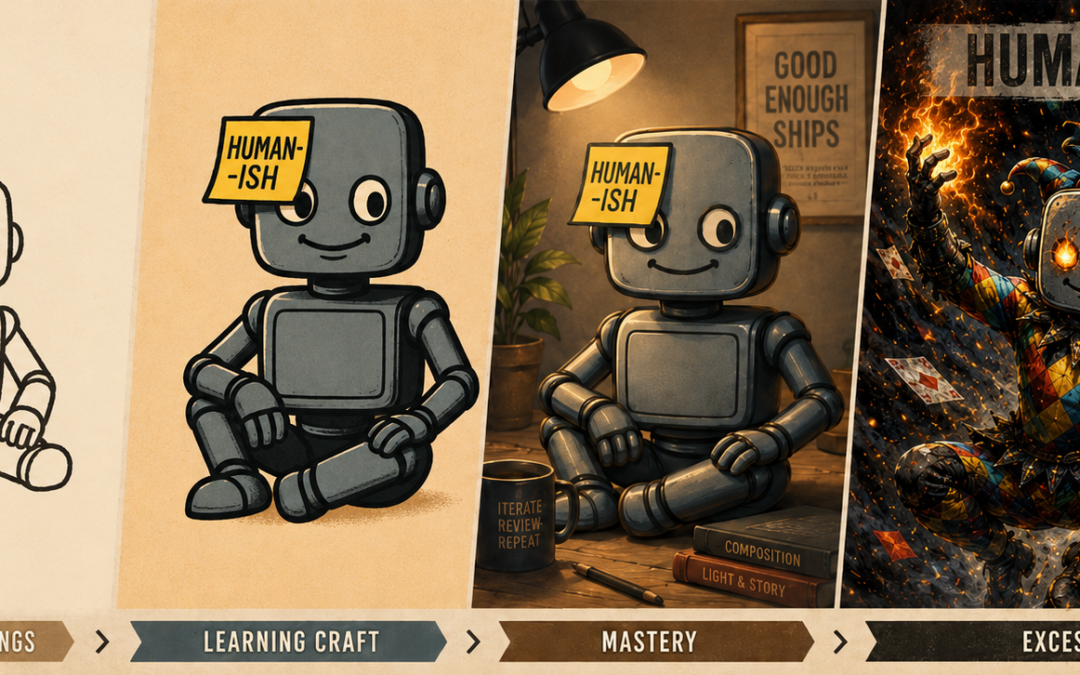
A tiny history of AI image style, and us too.
I have been watching AI-generated images change over time, and it has been interesting: at first it felt like a toy, then a tool, then a miracle, then suddenly everything is on fire.
Not metaphorically.
Literally.
Fire everywhere.
Grungy fire. Sparks. Smoke. Floating debris. A dramatic figure leaping through a vortex. Cards flying. Armor glowing. Eyes blazing. The whole image seems to be shouting, “Look what I can do!”
And to be fair, it can.
That is the problem and the wonder of it.
When I first started generating images with AI, the results had a kind of humble awkwardness to them. They were charming, sometimes weird, often imperfect. The robots looked like little storybook appliances. The lighting was soft. The characters had a handmade quality. It felt like the image model was still learning how to hold a pencil.
There was something lovable about that stage.
It did not know the full extent of its capability yet. Neither did we.
Then the images got better. Cleaner lines. More coherent anatomy. Better lighting. More intentional composition. The model learned craft. It started to understand what we meant when we said “cozy,” “editorial,” “cinematic,” or “storybook.” It stopped merely producing images and started producing specifically styled images.
For a while, that felt like magic.
Then came mastery.
The images became polished, controlled, and impressive. A person at a computer could look like a photograph. A robot could become a mascot. A fantasy scene could become a full movie poster. Textures improved. Faces improved. Lighting improved. The tool went from “Can it do this?” to “How specific can I be?”
And then, almost inevitably, came excess.
Because once a tool can do almost anything, the next question becomes: Why not add more?
More drama. More motion. More glow. More detail. More contrast. More atmosphere. More particles. More smoke. More fire.
Especially fire.
This is the part that feels deeply human to me.
The history of AI image generation feels like a tiny accelerated version of the history of humanity. We began with humble marks on walls. We learned how to make tools. We made shelters, then temples, then cathedrals, then skyscrapers. We learned to cover ourselves, then adorn ourselves, then create fashion so elaborate it becomes sculpture. We learned to tell stories around fires, then built theaters, then cinemas, then billion-dollar universes of spectacle.
At every stage, capability expands. And when capability expands, restraint has to become a choice.
That is not just true for humanity as a whole. It is true for a single human life.
We all start out awkward and experimental. We do not know what we are capable of yet. We make things because we are curious, not because we are trying to impress anyone. A child draws a person as a circle with lines coming out of it, and somehow it communicates everything it needs to communicate.
Then we learn craft. We practice. We copy. We improve. We discover rules. We discover tools. We learn what works.
Then, if we are lucky, we get good.
And getting good is dangerous.
Because once we can do more, we often assume we should. We over-explain. Over-design. Over-decorate. Over-prove. We add complexity where clarity would have been stronger. We mistake visible effort for value. We mistake drama for meaning.
We reach the personal version of grunge fire.
That phase can happen in design or writing. It can happen in careers and relationships. It can happen in faith, parenting, leadership, art, business, and even (maybe especially) self-improvement. At first, we are just trying to make something work. Then we learn how to make it good. Then we learn how to make it impressive. Then we have to learn something harder: when to stop.
That might be the real maturity curve → Discernment.
The question is not only, “Can I make this more impressive?” … the question is, “Does this need to be more impressive?”
The tiny robot with the sticky note that says “HUMAN-ISH” does not try too hard. It is simple and funny and vulnerable. It has one idea, and the idea is clear. Maybe that is why the evolution of these images is so fascinating to watch. AI does not just reveal what machines can do. It reflects what we ask for, what we reward, what we notice, and what we confuse with greatness.
We see the tool grow from awkwardness to polish to spectacle, and it feels familiar because we have done the same thing.
→ As a species.
→ As makers.
→ As individuals.
We begin humbly. We discover power. We learn craft. We chase greatness. Now we have to decide whether the next right thing is more fire — or less.